


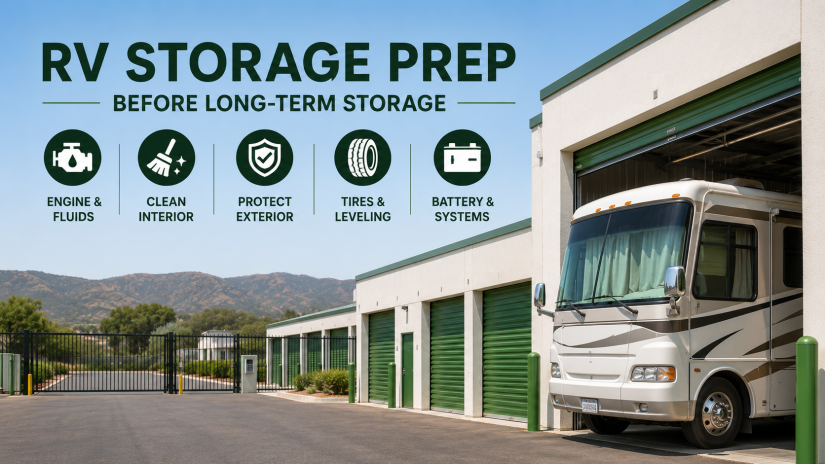


How to Prepare Your RV for Long Term Storage in Valley Center CA
Most RV owners in Valley Center do not think much about storage prep until the morning they are dropping their rig off and realize they forgot to do half the things they meant to. Then they spend the next few months hoping nothing goes wrong inside a vehicle they cannot see.
The Valley Center area is not particularly forgiving to a stored RV that was not prepared. The summer heat out here is real, the sun is intense, and even in the dry climate you get enough temperature swing between night and day to cause condensation problems inside a sealed vehicle.
None of that is a reason to panic. It is just a reason to spend a few hours doing things right before you hand your rig over for the season.
This is what that looks like in practice.
Sort Out the Engine and Fuel Before You Go Anywhere Near a Storage Facility
If you do nothing else on this list, do this one. Old oil sitting in an engine for four or five months is not just sitting there. It can contribute to low level corrosion on internal engine components. Change the oil before you store, even if you are not technically due for one. Fresh oil is inexpensive. Major engine repairs are not.
Top the fuel tank off and add a stabilizer before your last drive to the facility. The reason you fill the tank is to leave less air space where moisture can gather. The stabilizer keeps the fuel from breaking down into the kind of residue that can clog injectors and fuel lines. Run the engine for ten or fifteen minutes after you add it so the treated fuel circulates through the system.
While you are at it, check your coolant, brake fluid, and transmission fluid levels. Top off anything that needs it. If you are going into the cooler months, make sure your coolant mixture is rated for the temperatures you might encounter. Valley Center winters are generally mild, but occasional cold snaps do happen.
Your Interior Will Betray You If You Do Not Deal With It First
A sealed RV interior can develop problems surprisingly fast when it sits unused for months. Food attracts pests. Moisture builds up. Refrigerators develop mold.
Remove everything perishable. Every snack, every condiment, every half used bottle of anything. Clean the interior thoroughly, including cabinets, drawers, and the refrigerator. Pay attention to corners where crumbs and debris tend to collect.
Leave cabinet doors slightly open to improve air circulation.
The refrigerator is the item people most often overlook. Turn it off, clean it thoroughly, and leave the door propped open. A refrigerator that seals shut with residual moisture inside can develop mold quickly during long term storage.
Place a few moisture absorbers throughout the RV. Even in Valley Center's relatively dry climate, temperature swings can create condensation inside a sealed vehicle.
Get on the Roof Before You Store, Every Time
This is one of the easiest steps to skip and one of the most expensive mistakes to make.
Water can enter through a cracked seal around a vent, skylight, or rooftop unit, then sit unnoticed for months. By the time you discover the damage, the repair bill may be substantial.
Walk the roof before storage and inspect every seal around vents, skylights, air conditioning units, and other roof penetrations. If you notice cracks, gaps, or areas where sealant is pulling away, address them before storage rather than afterward.
A tube of self leveling sealant and a few minutes of maintenance can prevent much larger repairs later.
Clean the exterior and apply a UV protectant to rubber and vinyl surfaces, especially if you are using outdoor or covered parking instead of enclosed storage. The Valley Center sun can be tough on exposed materials over time.
Tires and Slide Outs Are Easy to Overlook
Tires can develop flat spots when a heavy vehicle remains in the same position for months. If you can place your RV on jack stands or tire cradles, it is worth considering. If not, try moving the vehicle slightly every month or two to shift the load.
Inflate your tires to the maximum recommended storage pressure before storing rather than your normal driving pressure. Tires naturally lose pressure over time, and starting higher provides a larger margin of safety.
Retract slide outs completely before storage. Extended slide outs place ongoing stress on seals and mechanical components and leave more surfaces exposed to the elements.
Do Not Leave Your Battery Connected and Walk Away
A battery left connected to an unused RV will slowly discharge. If it remains discharged for an extended period, sulfation can occur, permanently reducing the battery's capacity.
Either disconnect the battery and store it in a cool, dry location or connect it to a battery maintainer designed for long term storage. Both options work well. Leaving it connected and unattended generally does not.
Close the propane valve at the tank before storage. There is little reason to leave the system pressurized while the RV is not being used.
Enclosed vs Outdoor RV Storage Near Valley Center
Where you store your RV matters almost as much as how you prepare it.
Enclosed indoor RV storage provides the highest level of protection during long term storage. Your RV is protected from sun, wind, weather, and constant exposure to the elements.
Greens Storage Valley Center offers enclosed RV units with 12 foot and 14 foot tall doors, wide drive aisles designed for full size rigs, and an on site air and water station for final preparation before storage.
Outdoor covered parking is also available for owners looking for a more economical option. Both storage options are located behind gated entry with 24 hour camera coverage throughout the property.
Month to month leases mean you only pay for the time you need. When you are ready to pick up your RV and get back on the road, the process is simple.
Greens Storage Valley Center Serves RV Owners Across North San Diego County
The facility is located at 28407 Lizard Rocks Road in Valley Center with easy access from Valley Center Road. RV owners regularly store with Greens Storage from Valley Center, Escondido, Bonsall, Fallbrook, Ramona, Pauma Valley, and surrounding communities throughout North San Diego County.
